
Johnston Resident Lookup Record Coverage
Johnston County does not keep one official roll of every resident. A useful resident lookup is a sequence of separate checks. A tax card can identify the recorded owner and parcel details. A voter result can confirm registration information. A docket can identify a party in a court matter. Each answer has a different date, keeper, and limit. Use a property record to establish a parcel connection, not occupancy, and use a dated directory or obituary to support a historical conclusion.
| Record | What it can confirm | Johnston route | Access limit |
|---|---|---|---|
| Tax parcel card | Owner field, mailing and physical address, value and acreage | Tax Card and Sales Search | Free public route; assessment data need source checking |
| GIS parcel | PIN, mapsheet, township, ETJ and adjacent-parcel geography | Johnston MapClick | Free viewer; address database can be incomplete |
| Recorded instrument | Parties, date, book/page and legal description | Johnston Online Record Search | Index is public; image availability varies |
| Case summary | Party, filing, events and disposition | NC eCourts Portal | Confidential material and many images may be absent |
| Voter registration | Status, party, polling place, precinct and districts | North Carolina Voter Search | Current database; refresh date is not stated |
| Vital-record route | Custodian and eligible-copy path for a life event | NC Vital Records research | Not a free open certificate index |
| Heritage collection | Historical death, family, town and event clues | Johnston Heritage collections | Online indexes and on-site materials |
Start with the source closest to the question. A parcel or address question belongs in Tax Administration and MapClick. A current civic-record question belongs in Voter Search. For a dated legal matter, use eCourts and then the Clerk if a paper file is needed. Heritage collections can separate two people with similar names before an official copy is requested.
Johnston Resident Lookup Name Filters
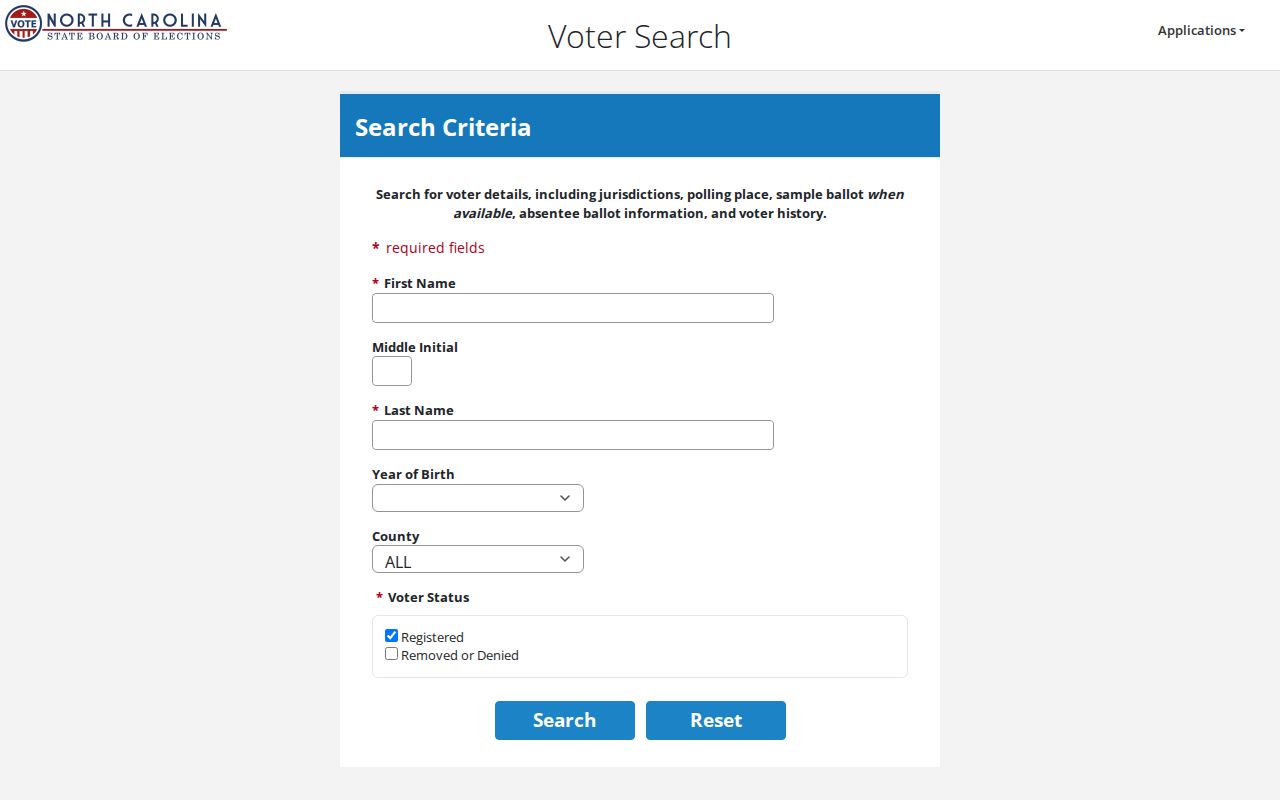
Write down the name exactly as it appears in the strongest record, then search practical variations: middle initial, suffix, alternate spelling, and a possible married name. For a common name, Johnston County is an important narrowing field. The public voter tool requires first and last name, requires at least one voter-status choice, and allows a middle initial, year of birth, and county filter. A no-match means only that no match appeared under the submitted filters. It does not prove that the person has never been registered.
| Required Voter Search fields | First name, last name, and at least one status choice: Registered, Removed, or Denied. |
|---|---|
| Optional narrowing | Middle initial, year of birth, and Johnston County. |
| Returned match | Registration status, party, polling place, precinct, district assignments, sample ballot when available, and displayed voter history. |
The official North Carolina Voter Search shows the form used for this check.
Use the returned status and election geography as current civic-record evidence, then compare it to an independently dated parcel, court, or historical record. A voter address can differ from a mailing address, and protected voters may have reduced location detail.
Note: Record the lookup date and exact filters because the public database is current but its refresh date is not stated.
Johnston Resident Lookup Court Searches
Johnston entered the eCourts pilot on February 13, 2023, and North Carolina completed statewide Odyssey implementation on October 13, 2025. The anonymous NC eCourts Portal is the first online route for a case summary. Smart Search accepts a case number, party name, or business name. A party last name needs at least three characters plus a wildcard, while a first name needs at least one character plus a wildcard. Case-number searches can use a wildcard after four characters, such as 21CR*.
| Smart Search | Case number, party name, or business name. |
|---|---|
| Filters | Case type, case status, court location, filing-date range, and date of birth. |
| Hearing search | Case, party, business, attorney, bar number, judicial officer, or courtroom. |
| Judgment search | Party or case, narrowed by type, status, location, or date. |
The Judicial Branch portal training documents these search controls and the portal’s result limits.
Use a county, case type, filing date, party role, and name variation together when a surname is common. The portal masks date of birth in results, so do not treat a partial date as complete identity proof.
Johnston Resident Lookup Result Fields
A court match should be saved as a case record, not folded into a generic person profile. The case number example 21CR000003-910 shows the year, case type, sequence, and county identifier. Capture the full case number before requesting a file. The online register can be near real time, but its event list does not establish that every pleading or item of evidence is available online.
- Case number, court location, case type, filing date, and assignment.
- Party names and roles, causes of action where shown, events, and hearings.
- Disposition, financial information, and judgment details if present.
- Whether a document image is available, rather than assuming an absent image means no file exists.
For estates, divorce, special proceedings, older civil or criminal matters, a copy request, or restricted material, use the Johnston County Clerk of Superior Court. The Clerk holds the paper file where the case is located and has a public self-service terminal or counter route. Page-based copy fees apply. That counter fallback matters when a portal result is incomplete.
Johnston Resident Lookup Vital Routes
Vital records answer a narrow life-event question and follow separate state and local paths. North Carolina Vital Records covers births from 1913, deaths from 1930, marriages from 1962, and divorces from 1958. For an earlier Johnston birth or marriage, begin with the Register of Deeds. Earlier deaths may require the NC Archives or local material, with some delayed death records reaching 1909. Divorce judgments belong with the Clerk where granted, even if eCourts has a case summary.
| Birth | State route from 1913; earlier Johnston material at the Register of Deeds. Application asks for full birth name, date/place, both parents, relationship, and requester identification. |
|---|---|
| Death | State route from 1930; earlier sources include the NC Archives and local routes. Application asks for name, date/place, relationship, and identification. |
| Marriage | State route from 1962; Johnston Register of Deeds holds earlier county marriage material. Both applicants, license date/place, and relationship are requested. |
| Divorce | State coverage starts in 1958, but the Clerk where granted is the route for the local judgment or earlier file. |
The official North Carolina vital-record ordering page displays the event-specific application routes.
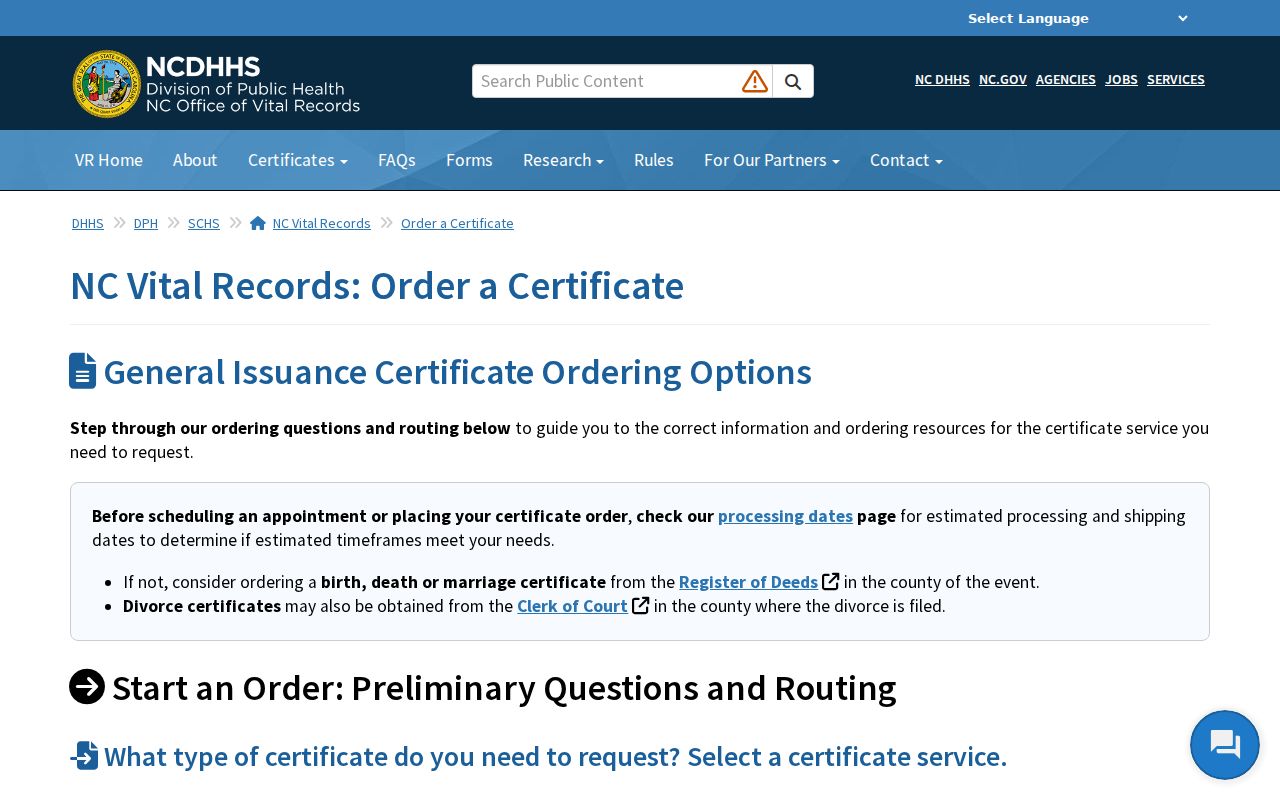
State searches start at $24 for one copy for each three-year period, while Johnston local charges and payment rules are separate. Certified birth and death copies are restricted by N.C.G.S. §§130A-93 and 130A-99 to specified relatives, legal determinations, and authorized representatives. There is no official blanket rule that every birth becomes open at 100 years or every death at 50 years. Confirm eligibility before paying the office handling the request.
Johnston History Resolves Same Names
The Johnston Heritage Center is the best local route when a modern search leaves two similar names. Its collections connect newspapers, obituaries, census material, marriages, voter material, cemeteries, images, yearbooks, and Register of Deeds links. The listed obituary index reaches from 1801 to the present. A spouse, parent, school, town, or obituary date can turn a weak name match into a more grounded candidate before an official vital-record request.
Older directories are dated snapshots, not current residency evidence. A printed address, telephone, or nearby name establishes only what the directory reported for that year. Search the alphabetical and street sections together, then use a deed, obituary, census record, or cemetery route as an independent check. The same care applies to a cemetery no-result, because record coverage differs by cemetery.
Johnston Resident Lookup Verification
One verification task is to test whether a name has a supported connection to a Johnston address at a particular time. Match the time period as closely as possible. A current tax owner, a current registration record, and a 1963 directory entry should never be presented as one undated fact. Keep a small evidence log with the source URL, lookup date, exact label, record year, and the conclusion that source can support.
- Normalize the name, including middle initial, suffix, alternate spelling, and any former surname.
- Search Voter Search with first and last name, then apply Johnston County and year of birth only when known.
- Search eCourts with name variants and narrow by location, case type, filing period, and party role.
- Use MapClick or Tax Administration to record the owner field, mailing address, physical address, PIN, and deed book/page separately.
- Confirm a historical address through a deed, directory, obituary, census, or another independent source before calling a match likely.
- Docket
- A court’s running list of filings, events, hearings, and dispositions for a case.
- Index versus image
- An index points to a record and its basic fields; an image is the underlying document when the custodian makes it available.
- Certified copy
- A copy issued by the custodian with the certification required for an official purpose; it has separate eligibility and fee rules.
- Situs address
- The physical location used for a parcel, which can differ from the owner’s mailing address.
For the full address-centered record chain, including adjacent parcels and deed links, use the Johnston by-street directory after the individual name has been separated from other matches.
Johnston Voter-List Insider Tip
The public lookup does not export every voter field. When a bounded civic-record question needs a street, walking-list, precinct, or ward arrangement, the county uses a separate voter-data request form. It allows a requester to select geography, registration or history data, and specific fields. Options include entire county, municipal area, commissioner or school district, precinct, ward, and several legislative districts. Request the narrowest area and the fewest fields that answer the question.
Johnston lists printouts or copies at 15 cents per sheet, labels at 40 cents per sheet, a USB at $10, and email delivery free. Payment is due before processing, and the stated minimum processing time is five business days. This request process is more precise than treating the ordinary name form as a whole-county resident export.
Note: A street-arranged list remains subject to protected-address rules and should be read as voter-record evidence, not proof of occupancy.
Johnston Resident Lookup Privacy
North Carolina Public Records Law, N.C.G.S. Chapter 132, does not open every field in every record. Do not copy Social Security numbers, driver-license numbers, banking information, full unmasked birth dates, or sensitive law-enforcement details. Johnston’s Register of Deeds has a redaction route for identifying numbers in a recorded document. If the image is redacted, report only that the source was redacted and use the custodian’s process. Do not try to reconstruct the missing text.
The North Carolina Address Confidentiality Program gives eligible survivors of domestic violence, sexual assault, stalking, or human trafficking a substitute address for mail and certain official functions. A participant can ask the Johnston Board of Elections to keep the voter address confidential. Reduced address detail is a stop condition, not an invitation to combine indirect records. Sealed court files, protected voter records, and restricted vital records also have their own rules.
Lawful use. Use Johnston records for personal, lawful research and keep conclusions tied to the source. Never use an address or record detail to stalk, harass, intimidate, or harm another person.
Johnston Resident Lookup Office Fallbacks
When an online index fails, ask the custodian for an existing record rather than a newly compiled resident list. Under North Carolina Public Records Law, a focused request can name a permit index by address and date range or a recorded instrument by book and page. If an office cites confidentiality, ask for the statutory basis and whether a redacted version exists. The Register of Deeds handles recorded documents and redaction questions, Tax Administration and GIS handle parcel fields, Elections handles voter protection, and the Clerk handles court-file access.
A portal no-result can reflect a search spelling, a date boundary, an incomplete map address database, a different jurisdiction, or a restricted record. For a court matter, take the case number to the Clerk. For a historic life event, use the state, Register of Deeds, Clerk, Archives, or Heritage route that fits the event and date. That is more reliable than drawing a broad conclusion from one blank screen.