
Johnston Address History by Era
The right starting point depends on the era. For a Johnston address that exists today, the Johnston Tax Administration Tax Card and Sales Search and MapClick can identify a current parcel, PIN, mapsheet, and deed book or page. The recorded deed then supplies a Johnston legal-description anchor. Earlier Johnston material moves through county books, heritage collections, digitized directories, and archival microfilm. Each source answers a narrower question than “who lived here before.”
| Source | Years it covers | Where held | What it shows |
|---|---|---|---|
| Johnston ROD historical indexing | 1746 onward reported; public search 1919-present reported locally | ROD portal, office, older books and indexes | Recorded owners, plats, legal descriptions, and related instruments |
| Johnston grantor/grantee books | 1746-1860 | Johnston genealogy resource | Book-by-book land index and names |
| ECU Johnston microfilm | Deeds 1749-1916; indexes 1749-1939 | ECU microfilm collection | Deeds, grants, and grantor/grantee indexes |
| Smithfield Sanborn | 1915 | Library of Congress | Building footprint, street, and block context |
| Directory sequence | 1930, 1947, 1957, 1959, 1961, 1963 | DigitalNC and Heritage routes | Name/address clues and historical block sequence |
| Heritage obituaries and census | Obituaries listed 1801-present; census years vary | Johnston Heritage Center | Kin, household, township, and historical context |
Begin with the current Johnston PIN, mapsheet, book and page, not a remembered street number. An old Johnston deed may use a rural route, subdivision name, or prior road name. The legal description and surrounding landmarks make a stronger bridge between current parcel data and an older Johnston address reference.
Johnston Recorder Search Split
The Johnston County Online Record Search is the public modern route, but its coverage needs careful wording. A local genealogy resource describes the public Johnston ROD search as 1919-present. Johnston County separately reports that land and vital records have been digitized from 1746 and that historical indexing continues. A Johnston result missing from the current web search is therefore not proof that no older instrument exists.
For a Johnston deed before the modern public-search range, use the county's older books and indexes, the Heritage Center, a FamilySearch or in-office terminal route where available, or the microfilm collection. The Johnston genealogy resource separately lists grantor/grantee books 1-35 for 1746-1860. Verify the matching Johnston book and page before treating an index entry as the recorded deed.
Johnston's Register of Deeds accomplishments page explains that Johnston digitization begins with records dating to 1746, while the current portal itself did not display a formal coverage-from label in the inspected form. Both facts belong in a careful past-resident search.
Note: Digitization and searchable indexing are related but different, so an older record may require a book, terminal, or archival route.
Johnston Deed Chain Backward
A chain of title is the sequence of recorded transfers for the same parcel. First obtain the current Johnston parcel anchors through the Johnston Tax Administration property route or MapClick, then use the current book and page in the Johnston Register of Deeds index. The grantee on the current deed is normally the buyer for that transfer. To move backward, the prior seller becomes the next name to test as a grantee, always checking dates and the legal description.
- Record the current Johnston situs address, PIN, mapsheet, subdivision or lot, current deed book/page, and legal-description landmarks.
- Find the current recorded instrument by book/page or party in the Johnston ROD search, then capture grantor, grantee, date, and document details.
- Search the earlier grantor as a possible grantee and compare the legal description, parcel identifiers, and dates before linking the transfer.
- Repeat the sequence backward, retaining plats, easements, rights-of-way, releases, and deeds of trust when they clarify the same property.
- When the online path ends, move to the 1746-1860 books or ECU microfilm rather than guessing from a surname match.
- Grantor
- The person or entity transferring an interest in the recorded instrument.
- Grantee
- The person or entity receiving that recorded interest.
- Chain of title
- A dated sequence of recorded property transfers linked by the same parcel or legal description.
- Legal description
- The deed's formal land description, which is often more durable than a street address.
Johnston Deed Search Insider Tip
Insider tip: The Johnston ROD search is broader than a surname box. Its separate Grantor/Grantee, Grantor, and Grantee groups provide surname, first-name, Soundex, Suggest Names, and Is Human controls. The form also supports book, page, document number, search string, start and end dates, and document types. Use the actual party side and document details instead of assuming a loose Johnston name result belongs to the parcel.
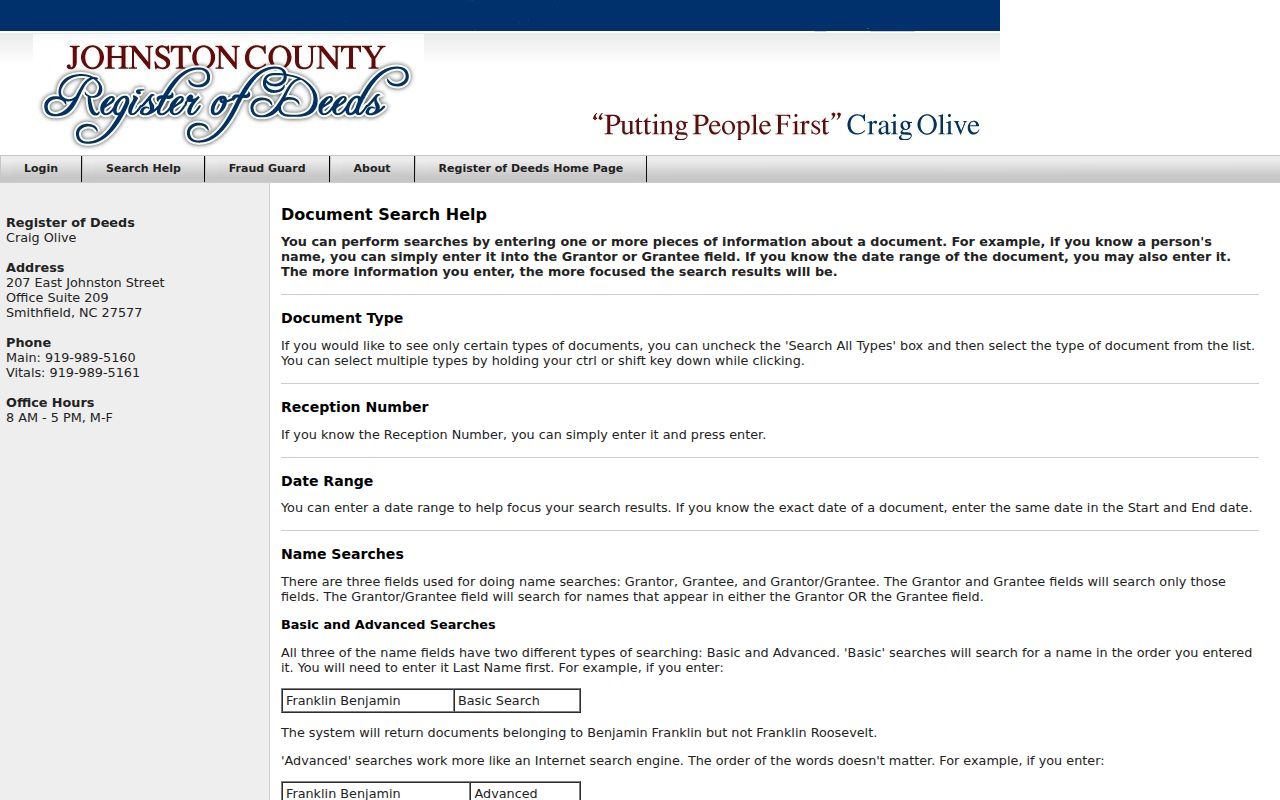
The Johnston ROD help page says basic name searches use last-name-first order. Advanced search makes word order irrelevant, supports * as a wildcard, and accepts + to require or - to exclude a term. An exact date uses the same start and end date. It also describes Johnston subdivision, block, lot, and reception-number routes.
The assigned search capture is sourced from the Johnston County Online Record Search, where an acknowledgement precedes the public index.
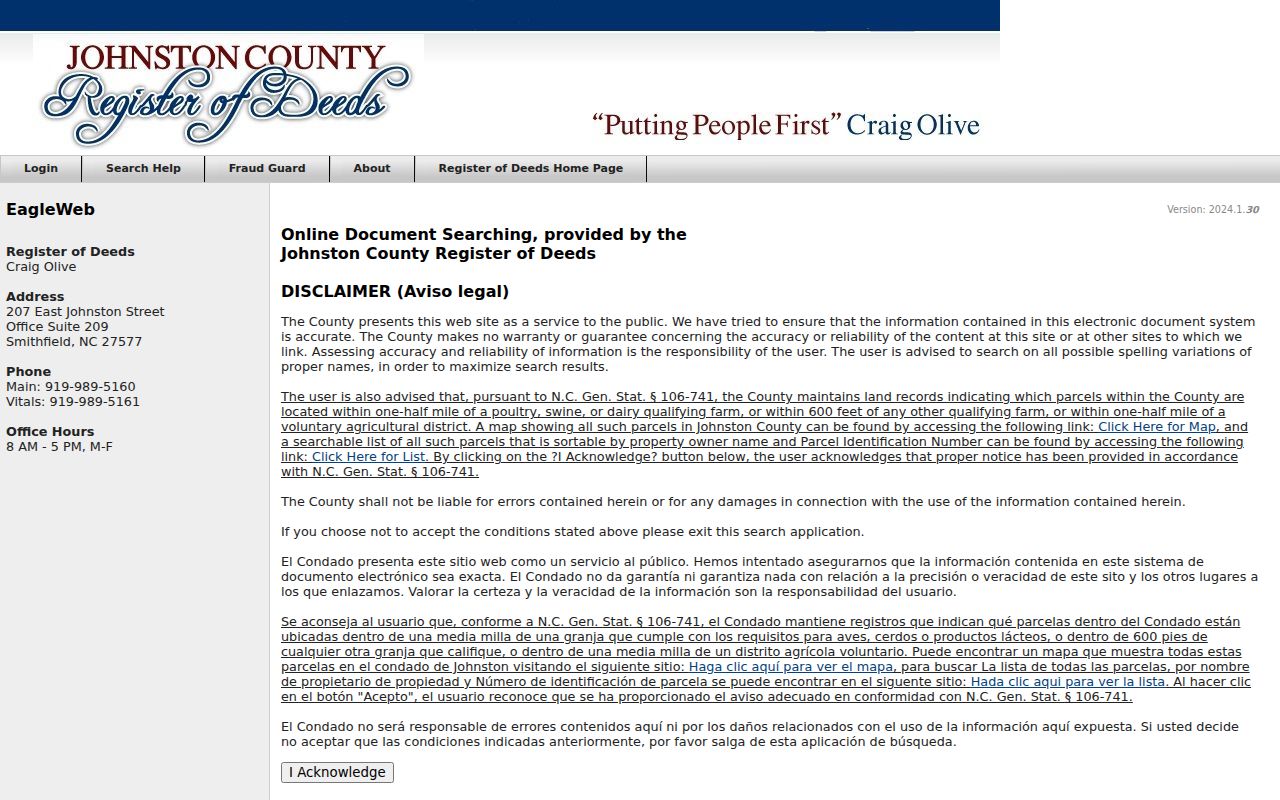
The Johnston deed-index view is an entry point for recorded instruments. It should be used with book, page, dates, and the legal description before a Johnston property connection is stated.
Johnston Past Residents in Directories
Deeds identify title events, not every person who occupied an address. The historical household layer comes from directory and census evidence. Search the 1963, 1961, 1959, and 1957 Smithfield-Selma directories by street and then by name. Add the 1947 Smithfield Chamber and 1930 Southern Bell directories where their local scope fits. The full collection and entry-reading method appear in the Johnston city directory collections.
Pair the first directory clue with the nearest appropriate census. Heritage lists online Johnston census collections for 1850, 1860, 1870, 1880, 1900, 1910, 1920, 1930, and 1940, while the state library guide identifies 1950 as the latest federal census currently available under the 72-year rule. Use the Johnston address, township, spouse, or neighbor clues to test a household, rather than treating a shared surname as enough.
- Start at the dated address in a directory street list and preserve the number, nearby numbers, intersections, and page.
- Move to the alphabetical listing for names, associated people, work clues, and any printed home notation.
- Compare the next available directory year, recording an address change, a gap, or a changed spelling as separate evidence.
- Check the closest census household and then an obituary, newspaper, yearbook, or cemetery record for an independent connection.
A Johnston directory-listed occupant may be a renter, boarder, or householder rather than the owner. Preserve that Johnston distinction throughout the house history.
Johnston Past Residents in 1915
The Smithfield Sanborn map set provides an eight-sheet September 1915 view of Johnston building footprints, street intersections, railroads, public buildings, and commercial blocks. It does not name every household. Its value is geographic: compare a Johnston footprint and intersection to a later street sequence, then to a deed, newspaper, or other record that names a person.
Story: A practical Johnston house-history chain can run from a 1915 Sanborn sheet to a 1930 telephone directory, then to a 1947 or 1957-1963 directory, and finally to a recorded instrument. The later Johnston directory can offer a number or nearby names; the map supplies the historical block. Keep each Johnston link qualified, especially where an old road name, municipal boundary, or street number may have changed.
Note: A Sanborn footprint confirms built-environment context, not a person's identity, so it needs a dated name source before a household claim.
Johnston Microfilm for Past Residents
When the deed chain reaches an older era, the ECU county-records-on-microfilm inventory gives a specific fallback. For Johnston it identifies deeds/grants from 1759-1842, deeds from 1749-1916, general grantor and grantee indexes from 1749-1939, County Court minutes from 1759-1868, estates from 1781-1868, accounts from 1808-1903, land entries from 1778-1926, marriage registers from 1760-1944, and cohabitation records from 1866. Select the Johnston series that matches the property era.
The North Carolina Archives Johnston records page adds series such as naturalization, powers of attorney from 1830-1924, road records from 1861-1918, and other miscellaneous holdings. Cite the relevant Johnston series and page. An archival result can explain a property's legal history, but it does not automatically establish the resident household.
The second assigned capture is sourced from the ROD grantor-grantee help, which documents related-document and subdivision search methods.
“Find Related” can follow documents that reference the current instrument or share a legal description, making it useful for testing a continuous parcel trail.
Johnston Previous Residents Myth
Myth: The person on a Johnston deed was necessarily the person living at the address. A recorded owner, a directory-listed occupant, and a person associated with the address are three different propositions. Johnston tax data also distinguishes mailing from physical or situs address. A mailing address can be outside Johnston County, and it does not establish occupancy of the parcel.
Label each Johnston conclusion with its source and date: recorded deed, directory listing, census household, obituary association, map footprint, or unresolved clue. The Johnston Heritage obituary index, listed from 1801 to the present, can supply a relationship or death clue, but it should be joined with the relevant Johnston historical address evidence. The same care applies when a cemetery result is absent, since local cemetery record coverage differs by site.
Lawful use. Johnston house-history research supports family history, estate questions, and personal curiosity. Do not use a historical address trail to stalk, harass, or harm a living person.
Johnston Previous Residents Evidence
Finish by returning to the current Johnston parcel record. Johnston Tax Administration and MapClick answer which parcel and tax account are involved; the Johnston Register of Deeds answers what was recorded and when. Keep the original Johnston PIN, current deed book/page, historical address wording, source date, and confidence label together. That compact record trail makes it possible to revisit a connection if a later deed, map, or directory page changes the interpretation.
For a present-day address chain along the same road, use the Johnston by-street directory. It is separate from the backward address trail because current parcel fields and historical household evidence are not interchangeable.