
Johnston City Directory Holdings
Johnston County historical directory evidence is concentrated in the Smithfield-Selma corridor. The runs do not form one uninterrupted annual series, so each volume must be cited by its own year and collection. For Johnston research, a telephone book may offer a name and address clue, while a Hill volume provides a stronger two-way name and street method. The Johnston Heritage Center adds school yearbooks that can supply a class, portrait, or activity context when a directory entry names the right person but not the relationship.
| Collection | Years | Where held | Access |
|---|---|---|---|
| Johnston Southern Bell telephone directory | 1930 | DigitalNC record 25517 | Check the digitized record and page scan |
| Johnston Smithfield Chamber directory | 1947 | DigitalNC record 25394 | UNC and Heritage digital collection route |
| Johnston Hill Directory Co. volumes | 1957, 1959, 1961, 1963 | DigitalNC Smithfield-Selma records | Digitized records and full-scan routes |
| Johnston Heritage yearbooks | 1926-1980, with school gaps | Johnston Heritage Center | Collection organized by school and year |
These Johnston holdings answer different questions. The 1957 Hill volume includes Pine Acres, Sandy Run, Sunrise Acres, and West Smithfield, while the 1930 volume includes Selma. Johnston coverage therefore depends on the particular town and year, not simply the county name on a search.
Note: A missing name can reflect a collection gap, local scope, or the directory's editorial choices rather than proof of no connection.
Johnston Heritage Directory Shelf
The Johnston County Heritage Center is the local starting point for the shelf around a historical volume. Its collection list names census, obituaries, marriage, birth, newspaper, soldier, voter, cemetery, image-archive, and yearbook material, as well as a catalog and research-services route. The Center reports online access to more than half a million Johnston County records. That breadth helps turn a short directory line into a researched historical lead without treating every collection as the same kind of proof.
The Heritage Center collection categories are documented at its online collections page. The site lists Johnston census collections for 1850, 1860, 1870, 1880, 1900, 1910, 1920, 1930, and 1940. It also lists a historical obituary index from 1801 to the present and Smithfield Herald headlines from 1885 through 2007. An obituary can provide kin or a death clue; a census or directory can place a Johnston household in a particular time and place.
The assigned capture comes from the Johnston County Heritage Center, the county's local-history and research-services hub.
The Heritage Center image points to the Johnston collection gateway, where a directory lead can be paired with a census, obituary, newspaper, cemetery, or yearbook record.
Reading Johnston City Directory Entries
The 1963 Hill Directory PDF supplies concrete rules for reading a Johnston entry. Numbered streets appear in numeric order, named streets alphabetically, intersections are shown, and buildings are listed in number order. Both sides of a street appear in one list. The alphabetical name department is where an individual, occupation, or business reference can be followed, while the street department gives the Johnston block sequence around an address.
| Name line | Identifies the person as printed, sometimes with a related person in parentheses. |
|---|---|
| Work reference | May name an occupation, employer, or business affiliation as the historical volume printed it. |
| Home notation | h introduces the home address in the 1963 examples. |
| Street listing | Can show building number, telephone notation, and adjacent entries in sequence. |
| Owner mark | @ is a family-reported owner mark that the publisher did not guarantee. |
- Criss-cross directory
- The street-order half of a directory, used to move from an address to the listed names nearby.
- Householder index
- A name-oriented portion that helps move from a person to a printed address.
- Abbreviation key
- The volume's decoding aid for its compact notation; preserve it with any transcription.
For example, the visible 1963 name entries include “Hill G Irwin (Ora J; Hill's Grocery & Market) h529 S 4th” and “Hill Reginald F (Shelby R) asst agrl extension agt Johnston County h115 W Davis.” Transcribe a Johnston line, cite its year, volume, and page, and explain any abbreviation. It records a historical publication, not a present-day claim about a person or parcel.
Johnston Directory Insider Tip
Insider tip: Use the Johnston 1963 street pages in both directions. The directory places 506, 507, and 509 in sequence on one visible street example, while intersections help anchor the block. Start with a house number, copy the nearby numbers and cross-street clue, then return to the alphabetical list for each name. This Johnston method is useful when an old address has a changed street spelling or when the name scan is hard to read.
The same volume says Johnston telephone numbers were taken as canvassed. Its @ mark means an owner notation reported by a family, not a publisher guarantee. Treat both details as evidence about the 1963 publication date. They do not establish current ownership, occupancy, or telephone use. The 1959 and 1961 Hill city directories support the same name-to-address, then address-to-name approach, but they should be compared rather than assumed to list every Johnston household.
Modern parcel work belongs in the Johnston by-street directory; the historical volume is strongest when it supplies the earlier address and block context.
Tracing Johnston Directory Households
A Johnston city directory trail works best as a dated sequence. Begin with the first plausible Johnston name or address in the appropriate volume, not with an assumption that the same spelling stays constant. Record the full printed line, page, street number, cross-street information, and any business or telephone clue. Then search the next available Johnston volume. The gaps between 1930, 1947, 1957, 1959, 1961, and 1963 are evidence gaps, so a move, death, or absence needs independent support.
- Choose a directory year that fits the known Smithfield-Selma or Selma connection, then capture the exact entry and page.
- Use the name section to record each printed address, spouse or related-person clue, occupation, and business reference.
- Read the street-order section for nearby numbers and intersections, then note any new household names.
- Pair the directory year with the closest available census, using the Heritage census holdings for household and township context.
- Check an obituary, newspaper headline, yearbook, cemetery entry, or recorded deed to test the historical connection.
A name leaving the list may mean a move, death, an unlisted household, or a changed editorial practice. It does not answer that question by itself. Label the result narrowly as a directory-listed person, recorded owner, census household, or obituary association.
Johnston Yearbook Directory Companions
The Heritage yearbook collection is arranged by school and year rather than by street. Its listed examples include Benson High in 1926, 1928, 1938-39, 1949, 1953, 1955-56, and 1960-64; Clayton High in 1926, 1952, 1956-58, 1960, 1968, 1971, and 1973-74; and Johnston County Training School/Johnston Central High in Smithfield in 1926, 1947, 1954, 1956, and 1958-69. The gaps matter. They are not a complete annual run.
A yearbook can corroborate a Johnston school, class, portrait, or activity context. The Heritage obituary index can add a relationship clue, and Smithfield Herald headlines can supply a Johnston event or organization clue. Each source has limits. A directory may carry a stale address, a newspaper index may not provide a street, and a deed can identify an owner without identifying daily residence.
The assigned collection capture is sourced from the Heritage Center's online collection categories.
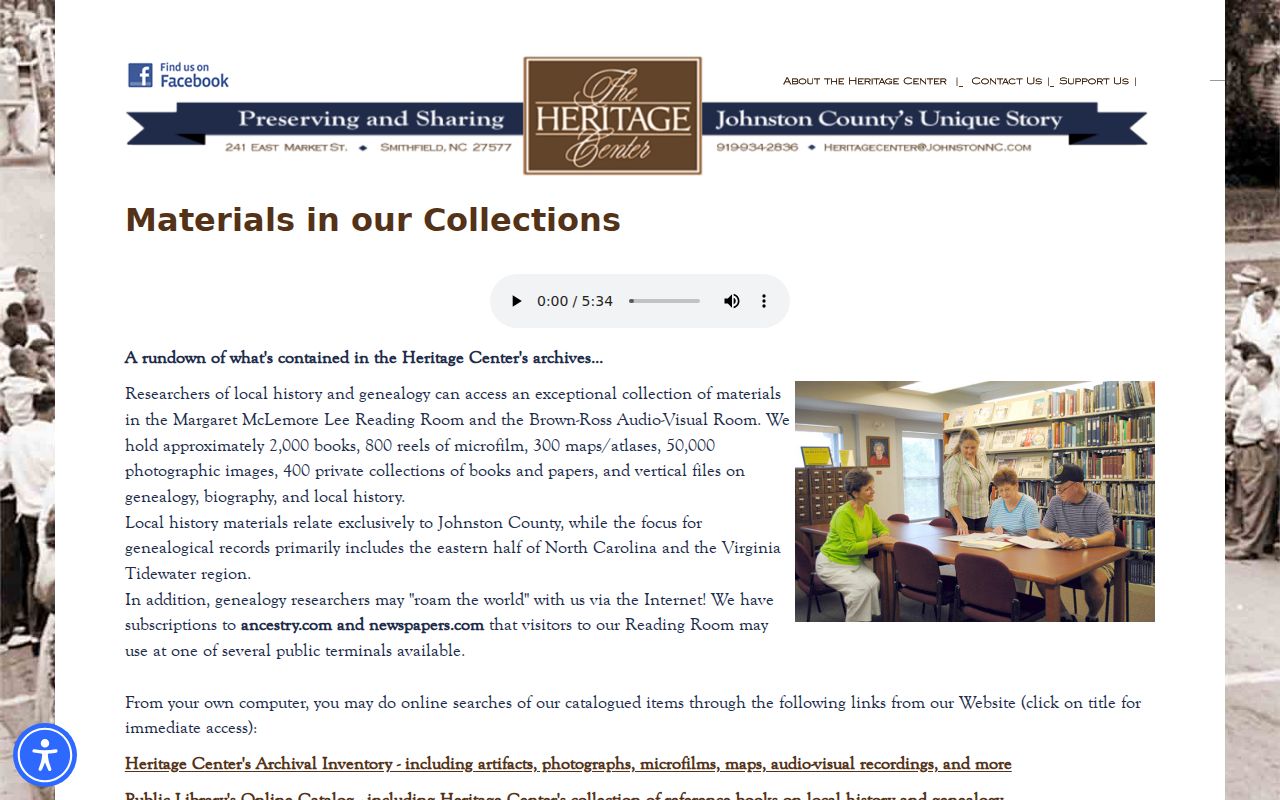
These Johnston collections show why a Johnston directory line should be joined to a source suited to the claim, rather than treated as a complete biography.
Note: Heritage lists its obituary index as 1801-present, but an index entry still needs its underlying notice or another source for careful interpretation.
Johnston Sanborn Directory Gaps
The Library of Congress Smithfield Sanborn set is dated September 1915 and has eight sheets. It can place a Johnston building footprint, street intersection, railroad, public building, or commercial block in a particular historical geography. It cannot name every household. The strongest Johnston chain is Sanborn sheet, then street number or intersection, then a 1930, 1947, or Hill directory, followed by a deed or newspaper reference.
When the historical shelf has a gap, move to the ECU Johnston microfilm inventory or the North Carolina Archives Johnston holdings. ECU identifies Johnston deeds from 1749-1916, grantor and grantee general indexes from 1749-1939, court minutes, estates, land records, and marriage registers. Cite the particular Johnston series and page instead of calling the whole archive a directory.
Johnston City Directory Timeline
The local chronology explains both the usefulness and the gaps in Johnston's historical volumes. It begins with a Johnston telephone directory, shifts through chamber and Hill volumes, and continues beside a much older Johnston land-record system. These dates are collection dates, not proof that every resident appears in every year.
- 1915: Smithfield's eight-sheet Sanborn set records built-environment context before the known directory sequence.
- 1930: Southern Bell provides the earlier Selma telephone-name and address clue.
- 1947: The Smithfield Chamber of Commerce volume supplies local business and residential context.
- 1957, 1959, 1961, 1963: Hill Directory Co. volumes provide the core Smithfield-Selma name and street sequence.
- 1926-1980: Heritage yearbook holdings add school-level evidence, with gaps by school.
Johnston County was formed in 1746, and the Johnston Register of Deeds reports continuing historical indexing alongside digitized land and vital records. That broader Johnston record history helps explain why an address question may require a directory, map, archive series, and recorded instrument rather than a single searchable result.
Johnston Directory Myth
Myth: A printed address or owner mark proves who lived at a place indefinitely. A Johnston historical volume is a dated snapshot. The 1963 @ mark was family-reported and not guaranteed by the publisher, and the telephone notation was canvassed. A listed home address is useful evidence for that volume, but it does not prove present residence, current ownership, or a continuing tie to a parcel.
Keep the Johnston proposition specific. “Directory-listed occupant” is different from “recorded owner,” “census household,” or “person associated with the address.” For a modern Johnston confirmation, use the relevant official record keeper and preserve both dates. This distinction makes city directories useful for family history without overstating what their compact entries can prove.