
Finding Johnston Resident Trails
Johnston does not keep one master list of everyone who lives in the county. Different custodians hold records for different events. Tax Administration and MapClick pair a parcel with a tax account. The Register of Deeds indexes recorded land instruments. The State Board of Elections confirms registration details. The Heritage Center holds dated local collections. A useful Johnston residents directory search begins with a name, address, or time period, then selects the source that can answer that narrow question.
Start with an address when the goal is a property connection. Start with a complete name and county when checking a current civic record or a court case. Start with a year and town for an earlier Johnston household. Each route can produce a lead, not a conclusion about present occupancy. County systems separately label recorded owner, mailing address, physical address, voter registration, and directory listing.
- Locate a present-day address in Johnston MapClick and save the PIN, mapsheet, and deed book/page.
- Use the Tax Administration route to check the parcel account and label owner, mailing, and situs fields separately.
- Search the Register of Deeds by party, book/page, document type, or legal-description connection.
- Use the North Carolina voter lookup or eCourts portal only for the source-specific record each returns.
- For an earlier household, pair a dated city directory with Heritage Center, obituary, census, or archive material.
Johnston Records Office Roles
Johnston County records become easier to read when the office role stays clear. The Register of Deeds keeps recorded instruments and local vital-record services. Tax Administration and GIS handle parcel clues. The Clerk holds court, estate, divorce, and special-proceeding files, while the state eCourts Portal provides an online case-summary route. Elections maintains the county-facing voter process. These sources intersect, but one office does not replace another.
Johnston County Register of Deeds
207 E Johnston St, Suite 209
Smithfield, NC 27577
919-989-5160
Johnston Board of Elections
205 S Second St
Smithfield, NC 27577
919-989-5095
Note: Johnston offices supply different records, so a parcel search, deed index, court file, and voter result should never be treated as interchangeable evidence.
Johnston Parcel Search Paths
The Johnston Tax Administration route is the direct property entry point. Its first screen offers Property Owner Name, Parcel Number, or Property Address. MapClick expands that route with Tax Number, Address, Deed Book/Page, Owner Name, Mapsheet, and twelve-digit NC PIN locators. It also supplies geographic filters for township, city limits, ETJ, subdivision, neighborhood, school, and emergency-service layers. The county says assessment data are compiled from public sources and may need confirmation against the source document.
| Johnston field | Use | Reading limit |
|---|---|---|
| Property owner name | Starts a Tax Card search | Owner of record is not an occupancy claim. |
| Address or PIN | Finds a parcel and mapsheet | MapClick says its address database is incomplete. |
| Deed book/page | Links parcel work to a recorded instrument | Confirm the instrument in the deed index. |
| Township, city limits, ETJ | Separates jurisdiction from postal wording | Postal city and municipal limit can differ. |
The Johnston by-street directory takes the full address workflow farther, including street queries and parcel layers. For a single record, retain the search input, returned PIN, source URL, and lookup date together. Owner, mailing, and situs address are separate fields. A tax bill sent somewhere else does not prove that its addressee lives on the parcel.
Source image: the Johnston Tax Administration property search shows the public property-search entry route.
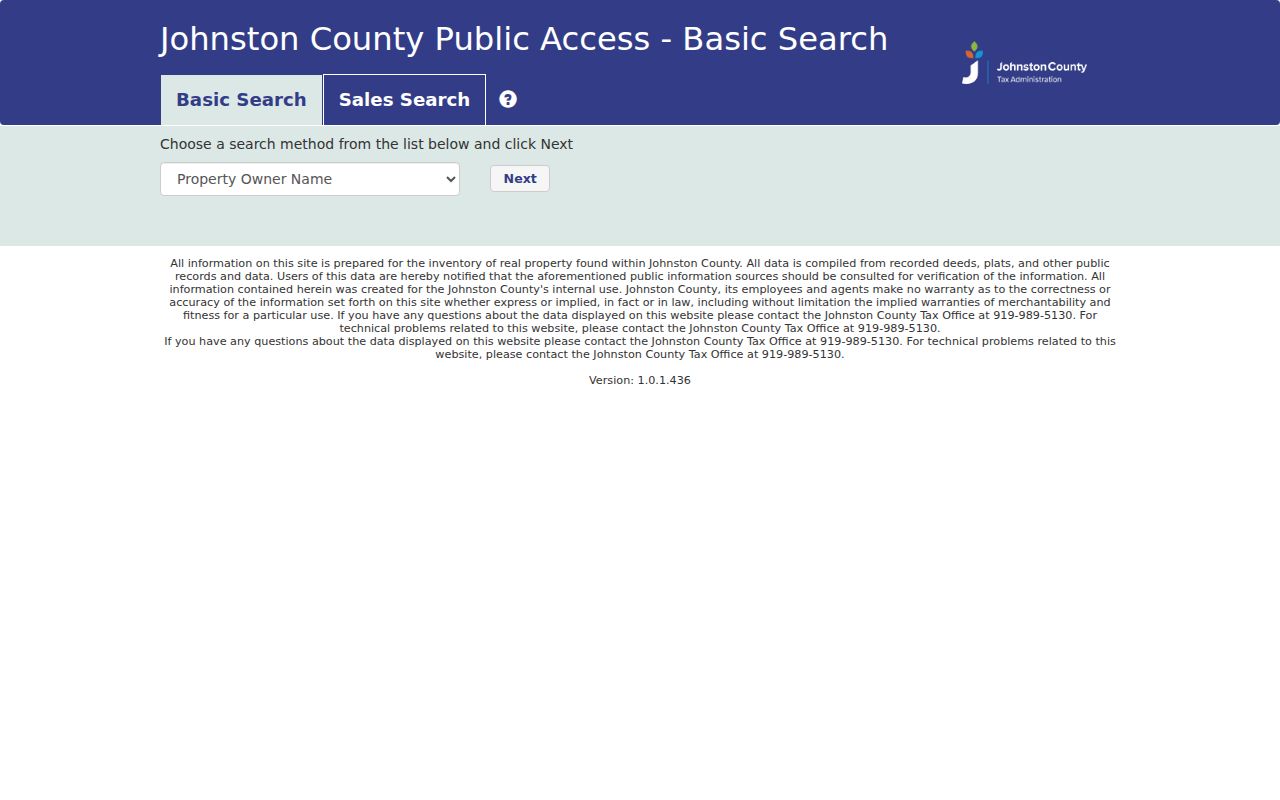
The form begins a parcel-account search and is not a complete roster of people at an address.
Johnston Deed Index Clues
The Johnston Register of Deeds public search is a separate step after a parcel is identified. Its form supports Grantor/Grantee, Grantor, and Grantee groups, with surname, first name, Soundex, and Suggest Names controls. It also supports document type, book, page, reception number, dates, subdivision, and related-document methods. Basic name searching uses last-name-first order. Advanced searching makes word order less important and accepts wildcard, required-word, and exclusion operators.
The county reports digitized land and vital material from 1746 with historical indexing continuing. A local genealogy resource describes the public online search as 1919-present and separately identifies grantor/grantee books for 1746-1860. Both statements matter. A Johnston residents directory result absent from the modern form may need older books, a local collection, a terminal, or archival material rather than a claim of nonexistence.
- Grantor
- The party transferring a recorded interest.
- Grantee
- The party receiving the recorded interest.
- Index
- A finding tool that points to a record; it is not a title opinion.
- Parcel
- A mapped tax unit with identifiers that can lead to a deed.
Source image: the Johnston Online Record Search is the county’s public deed-index entry screen.
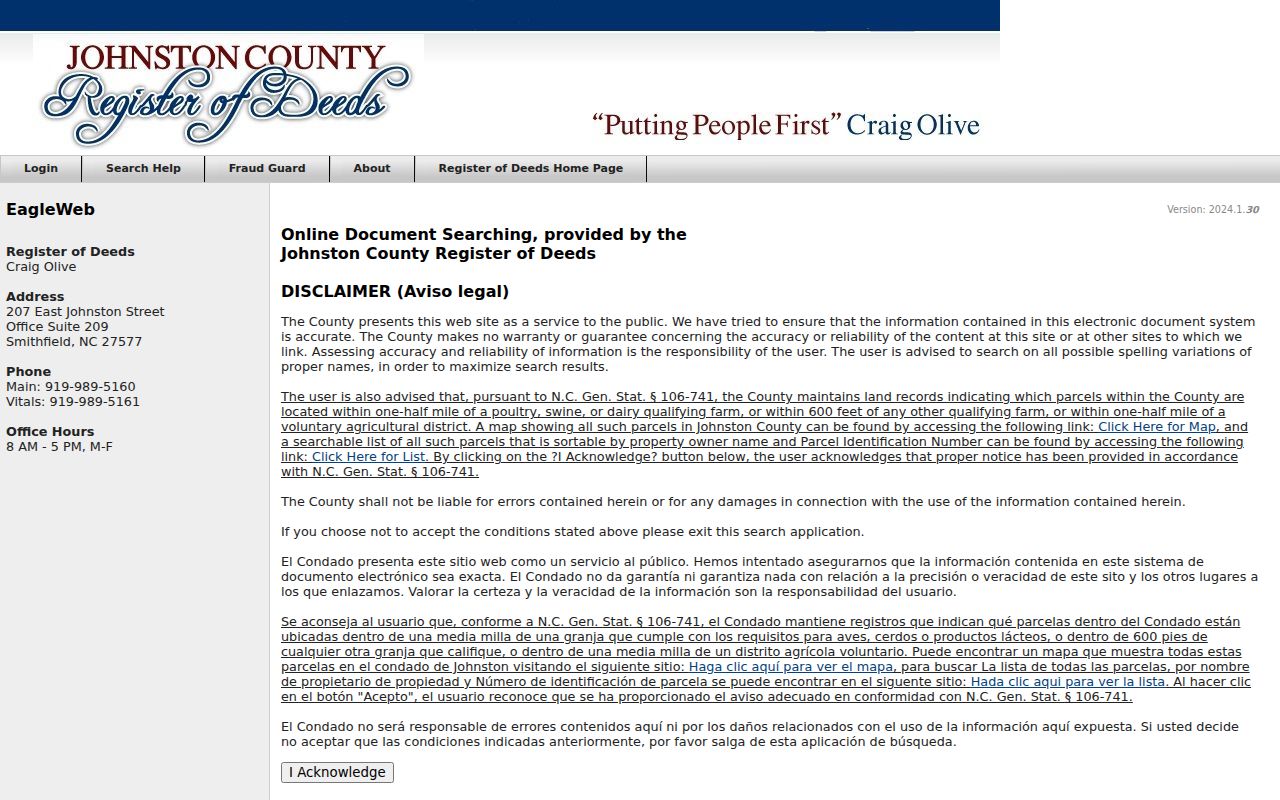
Use its party, date, document-type, and reference fields to locate a recorded instrument, then verify parcel and legal description.
Johnston Voter Record Checks
The North Carolina State Board of Elections Voter Search accepts first name, last name, optional middle initial, optional birth year, county, and status selection. Selecting Johnston County helps narrow a common name. A public match can show registration status, party, polling place, precinct, districts, displayed ballot information, and voting history when available. The inspected county materials did not give a database refresh date, so a result belongs with the search date and submitted filters.
For a broader civic-geography request, Johnston’s data form can request voter registration, history, or statistics and can arrange a list alphabetically, by street, walking list, precinct, or ward. It has geography, field, delivery, fee, and timing choices. The public lookup does not export that complete request. Protected-address rules, including the North Carolina Address Confidentiality Program, can limit what appears.
Source image: the official North Carolina Voter Search displays the name, birth-year, county, and status controls.
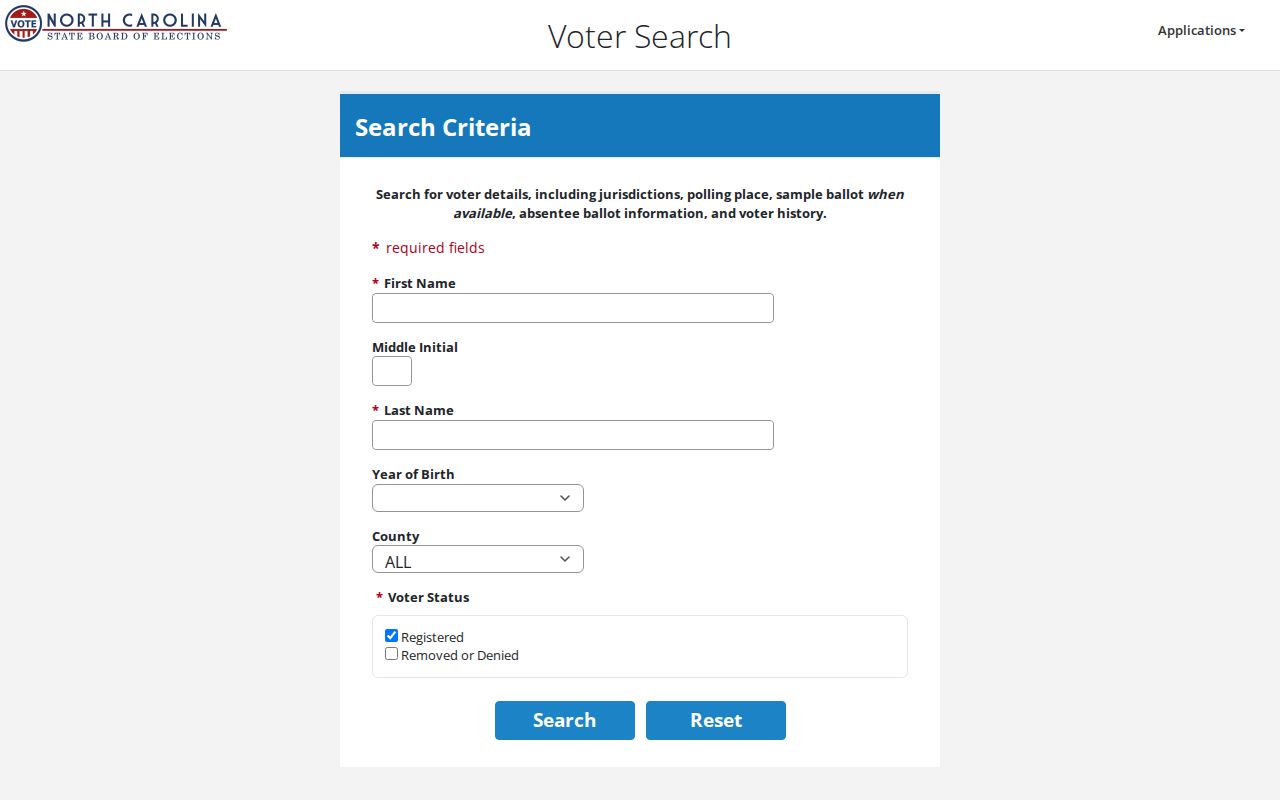
A no-match is only a no-match under submitted filters, not proof that a person was never registered in Johnston.
Johnston Court Record Names
Johnston joined the eCourts pilot in February 2023, and North Carolina completed statewide Odyssey deployment in October 2025. The North Carolina eCourts Portal permits anonymous Smart Search for a case number, party name, or business name. Its filters include case type, status, location, filing date, and a date-of-birth filter whose result display masks part of the date. Hearing and judgment searches use their own filters.
A court result can list a case number, location, type, filing date, parties, events, hearings, disposition, and other available summary fields. It is not automatically the full file. Sealed or confidential records and many images may not appear online. The Johnston County Clerk of Superior Court at 207 E Johnston St remains the route for a paper file, terminal access, or copies. Similar names need county, case type, party role, and filing date before they become a meaningful Johnston match.
Source image: the eCourts Portal Smart Search provides the public court-search landing screen.
The screen supports a case-summary path, while the Clerk’s office remains important for records not available as public images.
Current Johnston Directory Sources
Current Johnston resident directories are record-specific lists rather than a single roll. A tax parcel records an account and recorded owner field. MapClick adds parcel geography. The voter tool reports registration information. The deed index reports parties to recorded instruments. Each resource has a different date, keeper, and access rule. The table keeps those boundaries visible.
| Johnston source | What it can confirm | Access route |
|---|---|---|
| Tax Card and MapClick | Parcel, owner field, mailing and physical address | Free county property and GIS tools |
| ROD search | Recorded party, document, date, and book/page | Free public index; copies use county routes |
| NCSBE Voter Search | Registration status and election geography | Free public lookup; protected-address limits |
| eCourts Portal | Public case-summary and register information | Anonymous portal plus Clerk fallback |
| Heritage collections | Dated obituary, census, directory, and local-history clues | Online collections and in-person services |
A commercial people-finder category may combine stale or unverified data. Official Johnston sources make it easier to see what a record actually says and when it was created. For a person-specific chain, use the Johnston resident lookup process and compare independent sources.
Johnston Vital Record Routes
Vital-record questions require the right custodian and the right type of copy. North Carolina Vital Records maintains statewide birth records from 1913, death records from 1930, marriage records from 1962, and divorce records from 1958. Earlier routes can be different: Johnston Register of Deeds for earlier local births and marriages, the NC Archives for earlier deaths, and the Clerk for an earlier or local divorce file. A genealogy lead does not create certified-copy eligibility.
North Carolina General Statutes sections 130A-93 and 130A-99 govern information and copy rules. The state order process asks for exact names, dates, places, relationship, and record-specific details. Johnston’s local certified-copy instructions also use relationship and identification rules. State and local fees differ, so use the office selected rather than carry a fee from one route to another.
Source image: North Carolina Vital Records ordering shows the state application path and required-record routing.
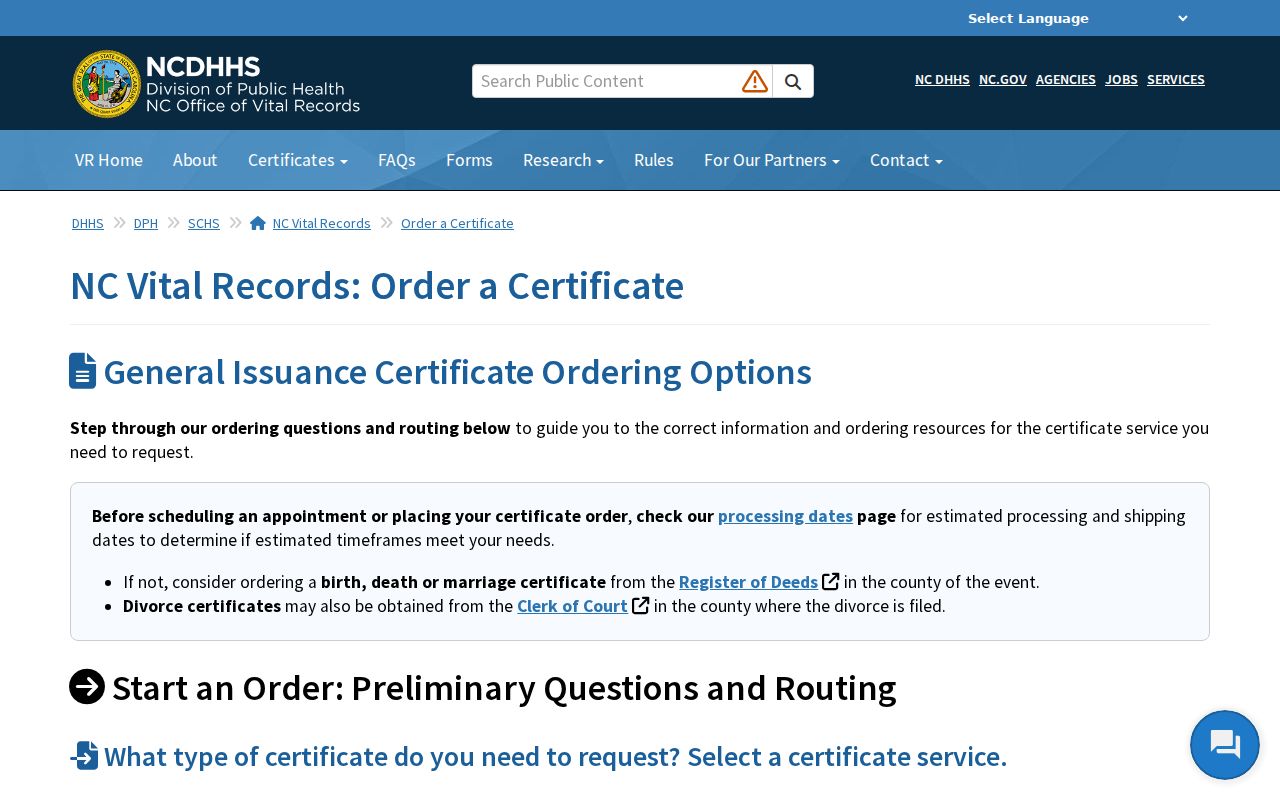
The state page helps identify the correct application path, while the local Register of Deeds and Clerk retain distinct Johnston responsibilities.
Johnston Historical Directory Shelves
Johnston historical resident research has a strong Smithfield-Selma shelf. DigitalNC records identify a 1930 Southern Bell directory, a 1947 Smithfield Chamber directory, and Hill Directory Co. volumes for 1957, 1959, 1961, and 1963. The 1963 volume is a 424-page scan. It orders numbered streets numerically, named streets alphabetically, shows intersections and both sides of a street, and lets an alphabetical name entry lead back to the street page.
The Johnston County Heritage Center at 241 E Market St brings together census, obituary, newspaper, marriage, voter, cemetery, image, and yearbook materials. Its online collection names obituary material from 1801-present and Smithfield Herald headlines from 1885-2007. A dated directory, obituary, census, or cemetery item should be labeled as that period’s evidence, not as a current Johnston residents directory claim. The full year-by-year collection method belongs on the Johnston city directories page.
Source image: the Heritage Center collections page identifies Johnston’s locally focused databases and research categories.
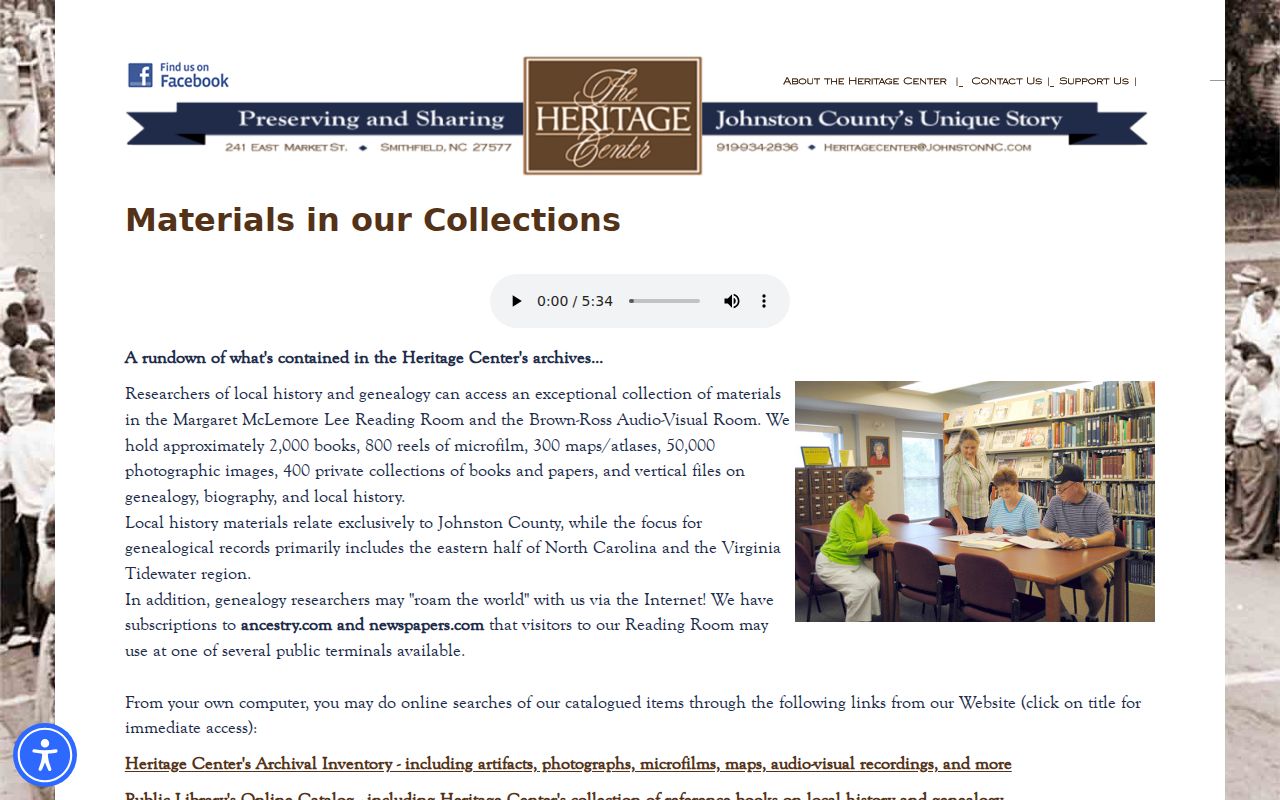
These collections provide a historical context layer that property, voter, and court records cannot supply by themselves.
Johnston Cemetery Directory Gaps
Cemetery material is another Johnston historical clue, but coverage differs sharply by cemetery. Smithfield’s Riverside has original deeds, lot-sale records, and a 1959 map, yet it has no interment records before 1989. John Thomas has no interment record or map. Resthaven and Oakland have deeds, maps, lot-sales records, and interments since 1989. Sunset Memorial Park and Riverside Extension have extensive original interment, deed, and map records. A negative result must therefore be read against the particular cemetery’s surviving record history.
Use a cemetery database for a name or burial lead, then confirm it through the responsible cemetery office, deed or lot material, obituary, and period directory where appropriate. A burial place can support a family-history trail, but it does not establish a person’s current address, property ownership, or household membership. The Heritage Center’s obituary and newspaper collections are helpful independent joins when the cemetery record is thin.
Johnston Records Request Routes
When no online path supplies the needed existing record, North Carolina Public Records Law provides an inspection and copy framework. N.C.G.S. Chapter 132 generally covers existing records, not a newly compiled residents list. A clear Johnston request names the record, office, date range, and desired format. For example, a requester can ask for an existing permit-application index for an address and date range, or identify a deed by book and page for an uncertified copy.
The correct fallback changes by keeper. The Clerk has court paper files and terminal access. The Register of Deeds can handle recorded-document copies when given a reference. The Board of Elections uses its data-request form for street, precinct, or other arranged voter data. Heritage collections, ECU microfilm, and NC Archives hold historical series outside a current portal. If a custodian cites confidentiality, ask for the statutory basis and whether a redacted version exists.
Johnston ZIP Geography Limits
A Johnston ZIP is a postal geography, not a parcel, city, or county boundary. The county ZIP map distinguishes primary entries such as Benson 27504, Clayton 27520, Four Oaks 27524, Selma 27576, and Smithfield 27577 from shared or partial areas. The county specifically warns that ZIP boundaries follow USPS boundaries and can cross municipal and county lines. Use USPS for one exact mailing address and MapClick for the parcel and jurisdiction.
Johnston address assignment adds a separate E-911 system. The county describes 10.56-foot intervals, odd/even sides, directional prefixes, and road-name conventions. The ZIP does not change through that county addressing procedure. An old road label may need extra care: local material describes almost eleven miles of NC 42 being renumbered NC 36 to reduce 911 confusion. That is a road-history example, not a rule for every address.
Note: A postal city can be useful for mailing, but Johnston MapClick city-limits, township, and ETJ fields are the better way to identify a parcel’s local geography.
Johnston Privacy Boundaries
North Carolina Public Records Law, N.C.G.S. Chapter 132, supports access to many existing public records, but it does not erase record-specific confidentiality. A Johnston deed may be public while sensitive personal numbers are subject to targeted redaction. A court summary may omit a sealed document. A public voter record can have protected-address limits. A vital-record application has separate statutory eligibility rules. Retain the least detail needed to identify a source and use its official correction or access route.
The North Carolina Address Confidentiality Program gives eligible survivors a substitute address for mail, voting, driver-license, and utility uses. A missing address can reflect a safety protection rather than an absent Johnston connection. Likewise, an online no-result can reflect a portal boundary, another custodian, a spelling issue, or a confidential record. It is not a reason to join indirect clues around a protected person.
Johnston Preservation Milestones
Johnston has two relevant record clocks. County material reports land and vital digitization from 1746 with continuing historical indexing. The modern public ROD search is described by a local genealogy resource as 1919-present. Keeping those dates together makes a negative portal result more useful. A researcher can choose a book-by-book index, Heritage Center, office terminal, ECU microfilm, or NC Archives series without claiming the underlying record never existed.
A second recent milestone concerns military discharges. On May 26, 2025, the Register of Deeds announced preservation of thousands of Johnston DD-214 records, including the county’s first dated January 30, 1922. The county explains that discharges within eighty years are not public and that older discharges are outside that restriction. Preservation helps locate the proper collection; it does not promise online access to a particular record.